Operation Unthinkable: the British plan to attack the Soviet Union, May 1945
Interactive case file about Operation Unthinkable, the plan Churchill ordered in May 1945 and the Joint Planning Staff delivered on 22 May 1945 (National Archives, CAB 120/691). Sections: the file, the plan with a map and force ratios, personnel cards, the leak to Moscow (the Cambridge Five), a timeline, the Iron Curtain, the Flensburg government, the atomic bomb, Ukraine today, a fictional shop and a podcast series of eleven episodes. Available in English and Czech. A plain-text version is at /llms-full.txt.
Interaktivní spis o operaci Unthinkable, plánu, který Churchill zadal v květnu 1945 a Joint Planning Staff dodal 22. 5. 1945. Česká verze: ?lang=cs.
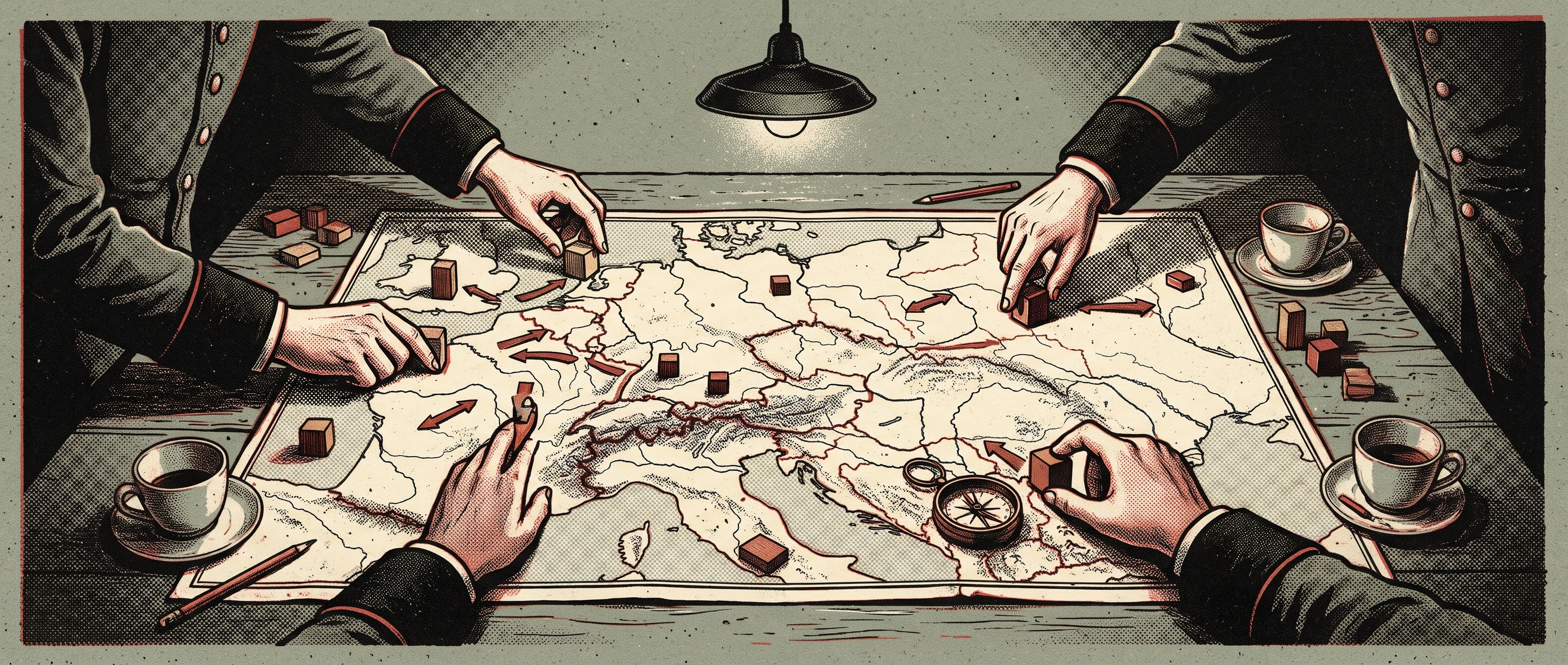
A war-room table: the map, the unit blocks, the arrows. AI illustration.Stůl ve válečné místnosti: mapa, figurky jednotek, šipky. Ilustrace vytvořená AI.
FromOd
Joint Planning Staff, United KingdomSbor společného plánování (Joint Planning Staff), Británie
ToKomu
Prime Minister Winston ChurchillPremiér Winston Churchill
DateDatum
22 May 194522. 5. 1945
SubjectVěc
Possible attack on the Soviet UnionMožnost útoku na Sovětský svaz
Two weeks after the war, Churchill asked for a plan for the next oneDva týdny po válce si Churchill objednal plán na další
Germany surrendered on 8 May 1945. Fourteen days later Churchill received a report he had asked for: how British and American troops could attack the Red Army. The plan was named Unthinkable.
Its stated aim was to impose upon Russia the will of the United States and British Empire. Politically, that meant above all a square deal for Poland. The attack was to begin on 1 July 1945. NA JW
The planners reached a different conclusion than Churchill wanted. The Soviets had roughly two and a half times as many divisions in Europe, and a quick, limited success was beyond our power. The plan was never launched and stayed secret until 1998. NA
Německo kapitulovalo 8. 5. 1945. O čtrnáct dní později dostal Churchill zprávu, kterou si objednal: jak by britské a americké jednotky zaútočily na Rudou armádu. Plán dostal jméno Unthinkable, nemyslitelné.
Za cíl si dal vnutit Rusku vůli Spojených států a Britského impéria. Politicky šlo hlavně o to, aby Polsko dostalo férové jednání (a square deal for Poland). Útok měl začít 1. 7. 1945. NA JW
Plánovači ale došli k jinému závěru, než Churchill chtěl. Sověti měli v Evropě přibližně dvakrát a půl víc divizí. Rychlý a omezený úspěch označili za mimo naše možnosti. Plán se nikdy nespustil a veřejnost se o něm dozvěděla až v roce 1998. NA
Declassified 1998Odtajněno 1998
Numbers differ between sources. Every claim shows where it comes from.Čísla se mezi zdroji liší. U každého tvrzení proto vidíš, odkud pochází.
Three questions in this fileTři otázky spisu
The plan of attackPlán úderu
The planners assumed a surprise attack around Dresden, in the middle of the Soviet front. Click the points on the map.Plánovači počítali s překvapivým útokem v oblasti Drážďan, uprostřed sovětské fronty. Klikni na body na mapě.
Schematic, not to scale. Borders as of 1945 (Historical Basemaps, approximate); the German occupation zones are tinted. The demarcation line is approximate.Schéma, ne přesné měřítko. Hranice podle stavu z roku 1945 (Historical Basemaps, přibližné), okupační zóny Německa jsou vybarvené. Demarkační linie je přibližná.
How the attack was meant to runJak měl útok probíhat
A swift, “Barbarossa-style” blow at Soviet positions near Dresden. NA
If that failed to force terms, push on towards Moscow, the Volga and the Caucasus and hold there until the USSR gave in. NA
Planners expected fighting to last into 1946 and Soviet reprisals in Iran, the Middle East and the Pacific. MHN
Some feared Stalin’s spies in London already knew. MHN
Rychlý úder „ve stylu Barbarossy“ na sovětské pozice u Drážďan. NA
Pokud by to nenutilo Sověty přistoupit na podmínky, pokračovat k Moskvě, na Volhu a do Kavkazu a držet je, dokud SSSR nepovolí. NA
Plánovači čekali boje až do roku 1946 a sovětské odvetné kroky v Íránu, na Blízkém východě a v Pacifiku. MHN
Někteří se obávali, že Stalinovi špióni v Londýně už o plánu vědí. MHN
An American counterpart, Operation Totality, existed but is far less known.Existovala i americká obdoba, operace Totality, ale je mnohem méně známá. LSE
Balance of forces in western Europe, 1 July 1945Poměr sil v západní Evropě k 1. 7. 1945
Estimate by the Allied planners. Soviet figures are division equivalents.Odhad spojeneckých plánovačů. Sovětská čísla jsou ekvivalenty divizí.
NA planners’ estimates as quoted in secondary literature; compare with CAB 120/691odhady plánovačů, jak je cituje sekundární literatura; srovnej s CAB 120/691
The report’s four assumptionsČtyři předpoklady zprávy
Public opinion in the British Empire and the US fully supports the operation.
Polish forces help fully, and German manpower and industry can be used.
Russia allies with Japan.
Hostilities begin on 1 July 1945.
Veřejné mínění v Britském impériu a USA operaci plně podporuje.
Plně spolupracují polské síly a lze použít německé lidi i průmysl.
Rusko se spojí s Japonskem.
Nepřátelství začne 1. 7. 1945.
NA Joint Planning Staff report, 22 May 1945, para 1zpráva Joint Planning Staff, 22. 5. 1945, odst. 1VerifiedOvěřeno
How many Germans was Churchill going to rearm?Kolik Němců měl Churchill v plánu znovu vyzbrojit?
Online encyclopaedia
up to 10 divisions from disarmed troops
Popular history magazine
up to 100,000 soldiers
Podcast
100,000 to 700,000 soldiers
Online encyklopedie
až 10 divizí z vojáků v zajetí
Popular history magazine
až 100 000 vojáků
Podcast
100 000 až 700 000 vojáků
Disputed The archived report assumes use of German manpower but gives no figure that could be checked against these numbers.
Sporné Archivní zpráva počítá s využitím německé pracovní síly, ale neuvádí číslo, které by šlo s těmito údaji porovnat.
Why the planners said noProč to plánovači odmítli
The Russians had a superiority of roughly three to one in central Europe. NA
Only about a third of Soviet divisions were of a high standard, yet they were formidable. NA
Russia could withdraw as it did against Germany, with virtually no limit to how far the Allies would have to go. NA
Russia’s military power would not be broken, and the fighting would become a world-wide struggle. NA
The Americans were shifting to the Pacific. Without them, Britain’s odds would be fanciful. NA
Převaha Sovětů zhruba tři ku jedné ve střední Evropě. NA
Jen asi třetina sovětských divizí byla vysoké kvality, přesto byly impozantní. NA
Rusko mohlo ustoupit do hloubky země jako proti Němcům, prakticky bez limitu. NA
Vojenská moc Ruska by nebyla zlomena a konflikt by se rozšířil na celosvětový zápas. NA
Američané přesouvali síly na Pacifik. Bez nich by šance Británie byly podle zprávy fanciful (fantazijní). NA
Personnel cardsOsobní karty
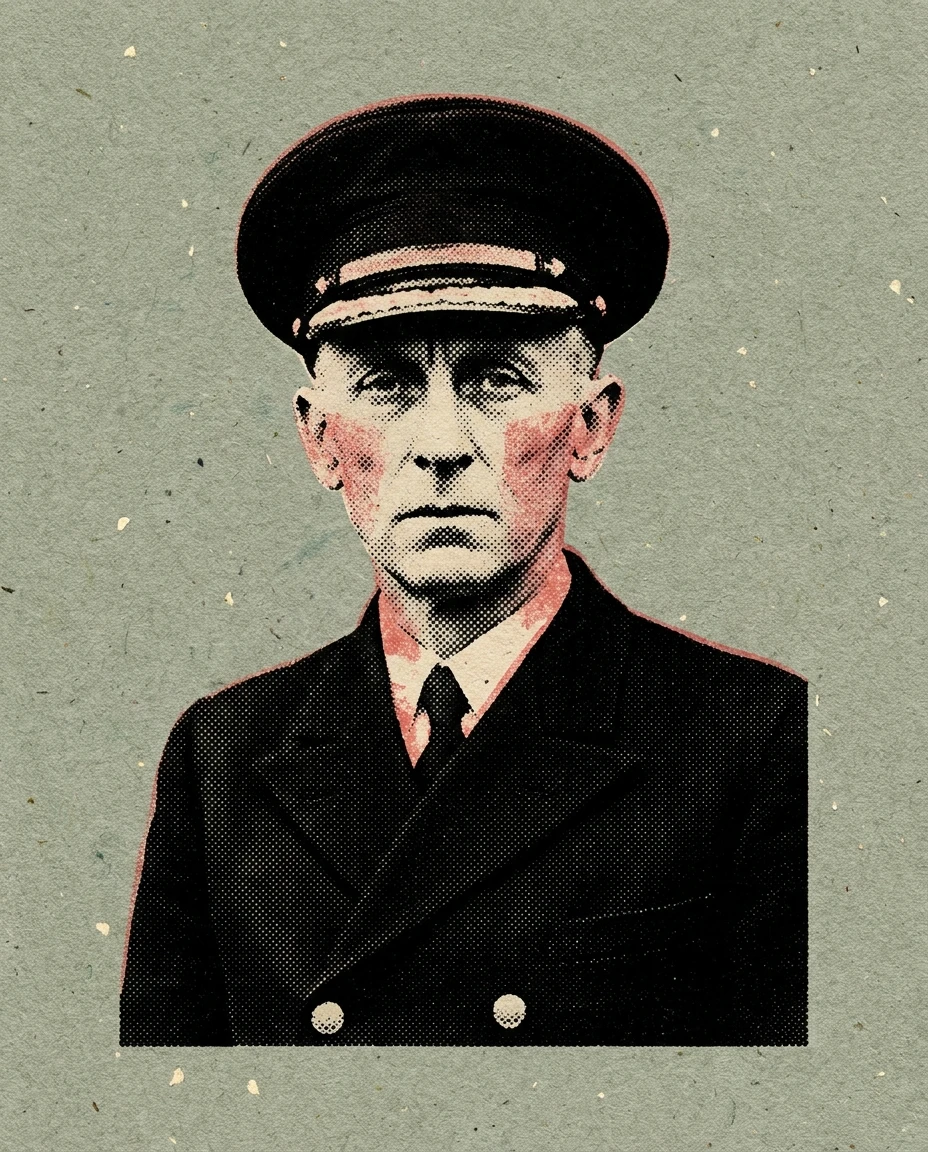
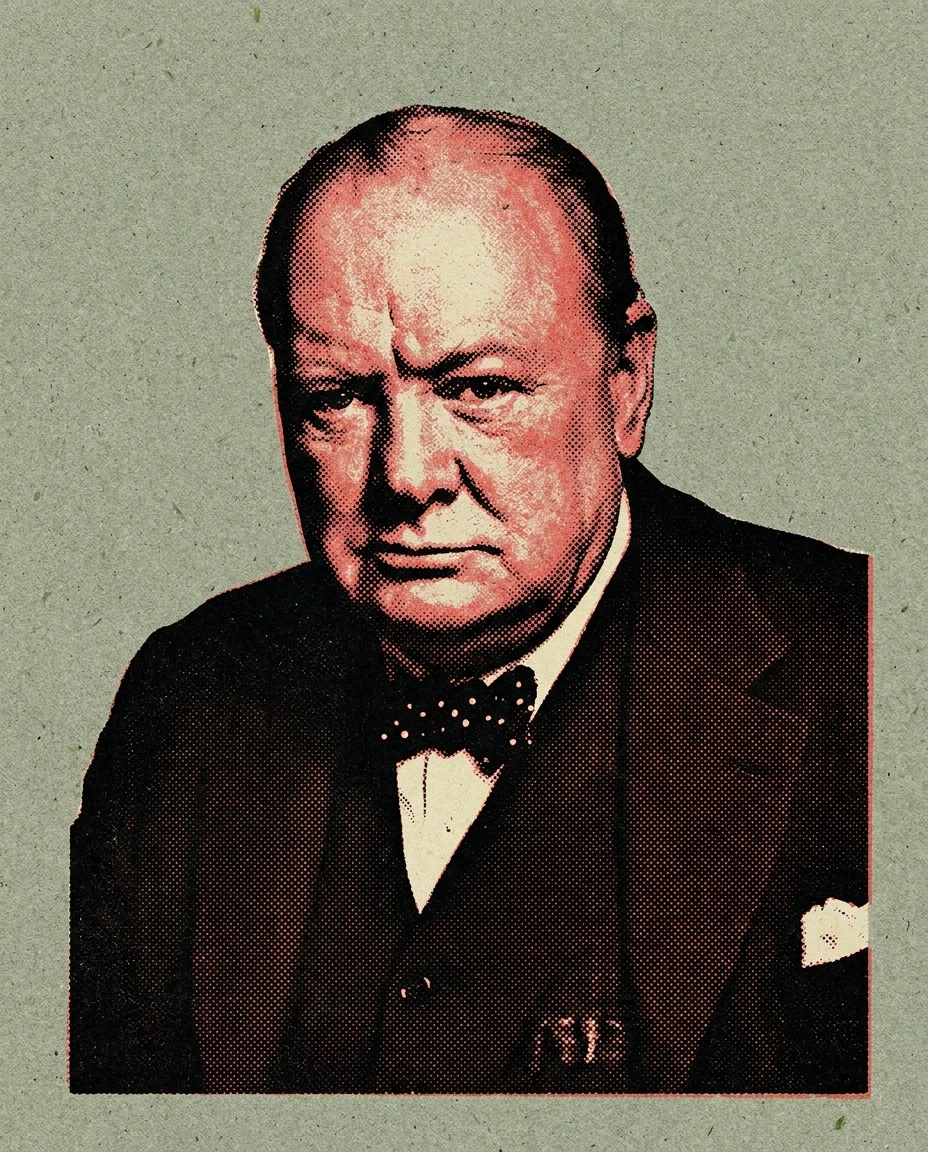
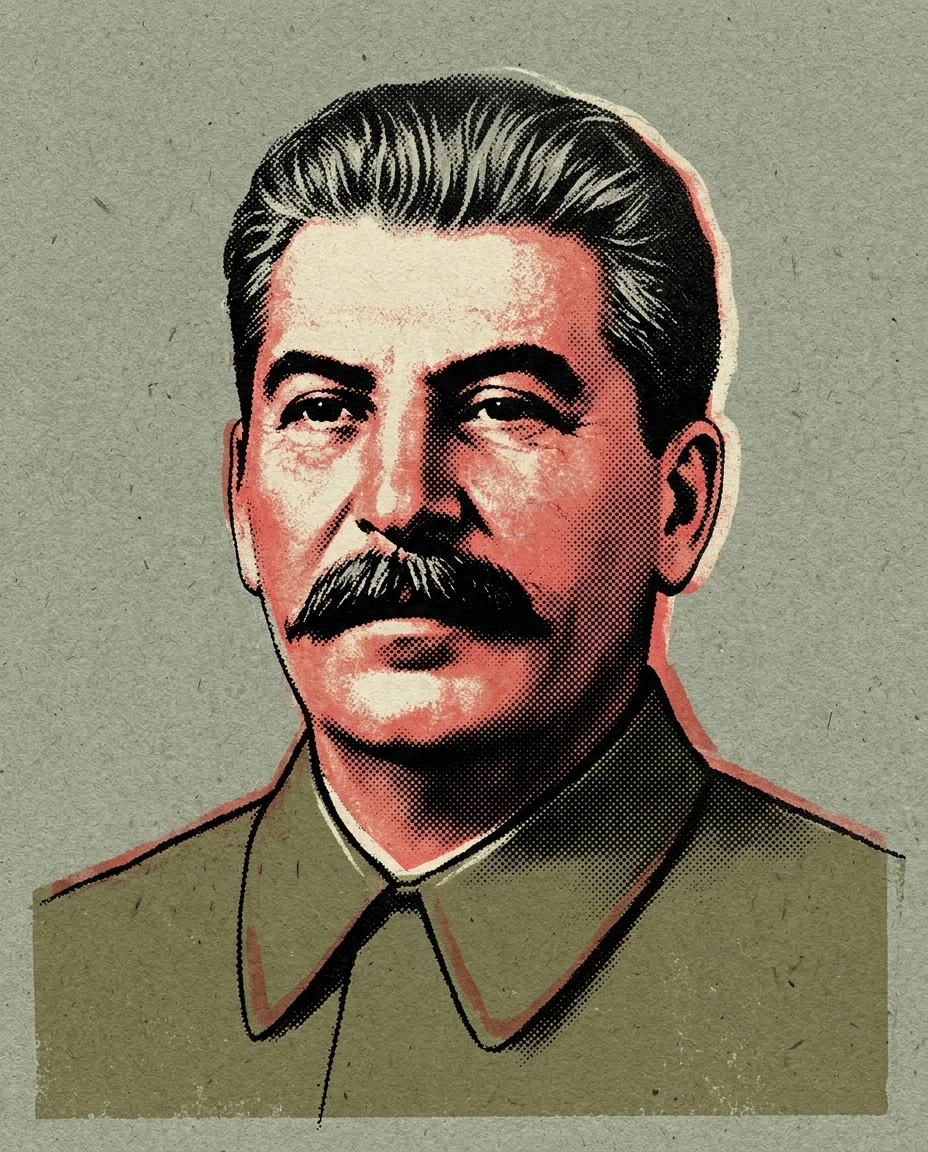
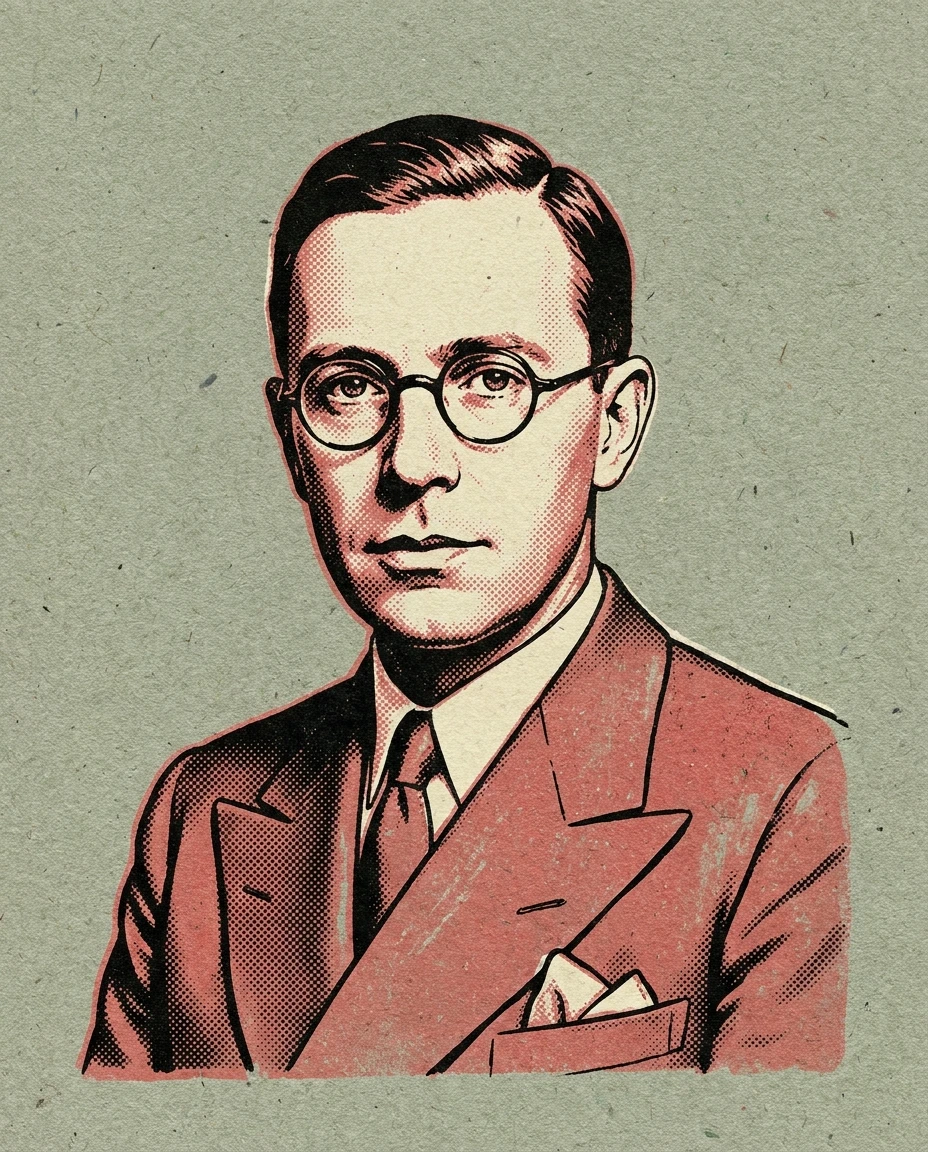
Stylised illustrations, not photographs. Likenesses are approximate.Stylizované ilustrace, ne fotografie. Podoba je přibližná.
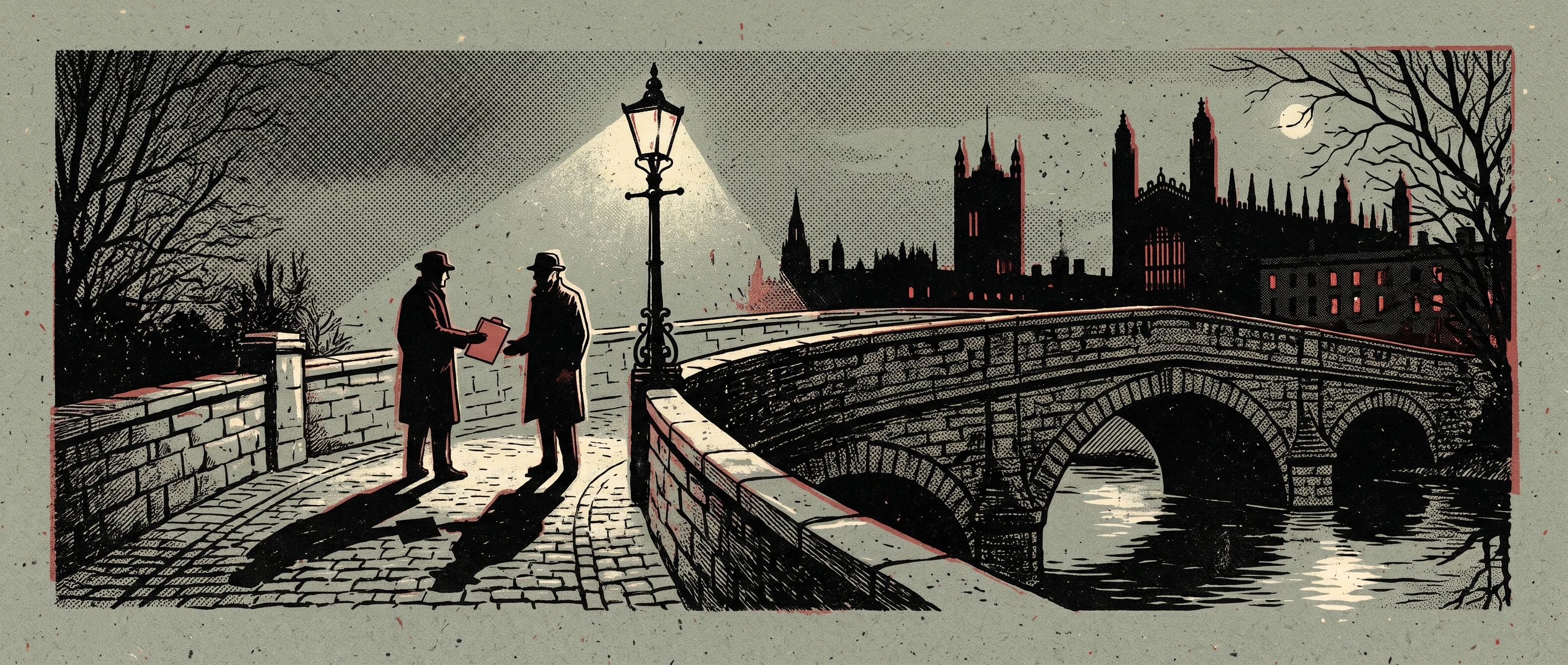
Night on a bridge: the folder changes hands. AI illustration.Noc na mostě: složka mění majitele. Ilustrace vytvořená AI.
Who told Moscow?Kdo to řekl Moskvě?
The plan was secret and known to a narrow circle at the top of the British military. According to his biographer Andrew Lownie, Guy Burgess passed its details to Soviet intelligence at the time. Lownie Disputed
Other accounts name Donald Maclean as well. No archive document available for this file shows who passed the plan on, or by what route.
Plán byl tajný a znalo ho úzké vedení britské armády. Podle jeho životopisce Andrewa Lownieho ale Guy Burgess předal podrobnosti sovětské rozvědce už tehdy. Lownie Sporné
Jiné výklady jmenují i Donalda Macleana. Žádný archivní dokument dostupný pro tento spis neukazuje, kdo plán předal ani jakou cestou.
Five suspectsPětka podezřelých
CAB 120/691Operation Unthinkable 22 May 1945Operace Unthinkable 22. 5. 1945
The five are drawn in shadow on purpose: these are illustrations, not likenesses.Pětice je záměrně nakreslena ve stínu: jde o ilustrace, ne o podobizny.
Documents passed to the Soviets, 1941 to 1945.Počet dokumentů předaných Sovětům v letech 1941 až 1945. Lownie
What the plan did in MoscowCo plán způsobil v Moskvě
A popular account holds that Stalin dug in after the leak: he sped up the political takeover of eastern Europe, and Marshal Zhukov was ordered to move troops to defensive positions, dig trenches and prepare anti-tank lines.
Unverified No document in the archive confirms these orders. Historians have not shown how much the plan itself shaped Soviet decisions.
Populární výklad tvrdí, že Stalin se po úniku zakopal: urychlil politické ovládnutí východní Evropy a maršál Žukov dostal rozkaz přesunout jednotky do obrany, kopat zákopy a připravit protitankové pozice.
Neověřeno Žádný archivní dokument tyto rozkazy nepotvrzuje. Historici neprokázali, nakolik plán sám ovlivnil sovětská rozhodnutí.
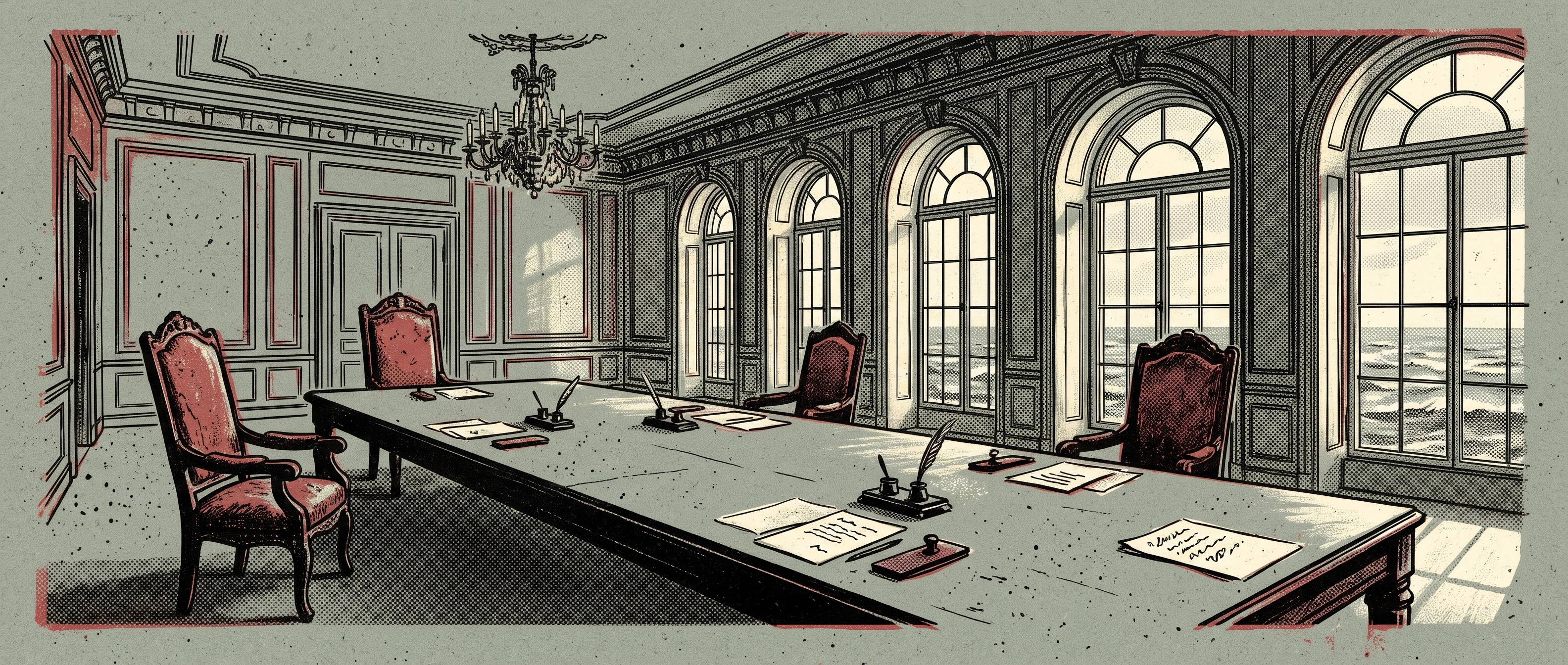
A room at Yalta, three armchairs. AI illustration.Sál na Jaltě, tři křesla. Ilustrace vytvořená AI.
From Yalta to NATOOd Jalty k NATO
The curtain was realOpona byla skutečná
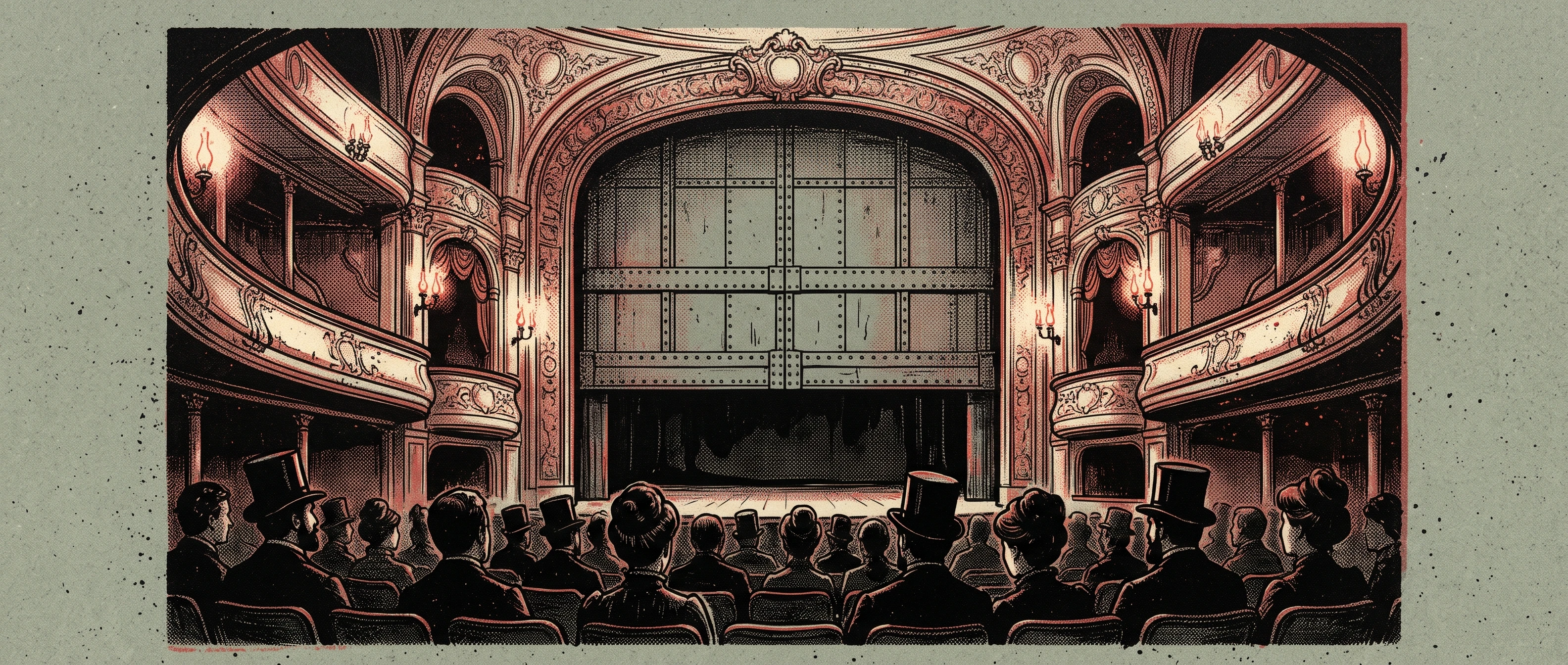
Before it was a border, an iron curtain was a piece of theatre equipment: a fire-safety curtain, originally made of metal, lowered between the stage and the audience to stop a fire spreading. Churchill did not invent the phrase. He gave a known word a new job.
In nineteenth-century theatres, lit by gas, a massive iron curtain was dropped to seal off the stage when a fire broke out. The timeline below follows the phrase from there to Fulton.
Než se stala hranicí, byla železná opona kusem divadelního vybavení: protipožární oponou, původně z plechu, která se spouštěla mezi jeviště a hlediště, aby se oheň nešířil. Churchill to slovní spojení nevymyslel. Dal známému slovu novou práci.
V divadlech 19. století, osvětlených plynem, se při požáru spustila masivní železná opona a uzavřela jeviště. Časová osa níže sleduje cestu tohoto spojení až do Fultonu.
Stettin – TriesteŠtětín – Terst
You can raise this curtain with one click. For more than forty years, the people of Central and Eastern Europe could not.Tuto oponu zvednete jedním kliknutím. Lidé ve střední a východní Evropě to přes čtyřicet let nemohli.
1946 – 1989
A gaslit theatre and its iron curtain. AI illustration. Drop it to see where Churchill drew it in 1946.Divadlo osvětlené plynem a jeho železná opona. Ilustrace vytvořená AI. Spusť ji a uvidíš, kde ji Churchill vedl v roce 1946.
How the phrase travelledJak se spojení šířilo
An iron curtain at Drury LaneŽelezná opona v Drury Lane
A theatre-history site says the third Theatre Royal, Drury Lane, was fitted with an iron safety curtain. Such curtains were made of sheet metal, hence the name.
Web o historii divadel uvádí, že třetí Theatre Royal v Drury Lane dostalo železnou bezpečnostní oponu. Takové opony se dělaly z plechu, odtud název.
UnverifiedNeověřeno HTP
Ringtheater fire, ViennaPožár Ringtheateru ve Vídni
The theatre had an iron curtain, but it was not lowered. Sources give at least 384, 386 or 620 dead. A law of 1882 brought in measures including the iron curtain.
Divadlo železnou oponu mělo, ale nespustila se. Zdroje uvádějí nejméně 384, 386 nebo 620 mrtvých. Zákon z roku 1882 zavedl opatření včetně železné opony.
VerifiedOvěřeno Austria-Forum
Exeter theatre firePožár divadla v Exeteru
Nearly two hundred died. The same site says it helped make safety curtains standard in British and American theatres.
Zahynulo téměř dvě stě lidí. Tentýž web uvádí, že to pomohlo udělat z bezpečnostních opon standard v britských a amerických divadlech.
UnverifiedNeověřeno HTP
First known political use in printPrvní známé politické užití v tisku
The philosopher Vasily Rozanov writes of “an iron curtain descending on Russian history”.
Filosof Vasilij Rozanov píše o „železné oponě, která se spouští na ruské dějiny“.
VerifiedOvěřeno WCS
Behind an “Iron Curtain”Za „železnou oponou“
Ethel Snowden’s Through Bolshevik Russia describes Russia as lying behind one.
Kniha Ethel Snowdenové Through Bolshevik Russia popisuje Rusko jako zemi za ní.
VerifiedOvěřeno WCS
Goebbels uses itGoebbels ho používá
The Nazi propaganda minister uses the phrase in his weekly Das Reich.
Nacistický ministr propagandy používá spojení ve svém týdeníku Das Reich.
VerifiedOvěřeno WCS
Churchill to TrumanChurchill Trumanovi
His first known use: “An iron curtain is drawn down upon their front.” Sources differ on the exact wording and on whether it was a letter or a telegram.
Jeho první známé užití: „An iron curtain is drawn down upon their front.“ Zdroje se liší v přesném znění i v tom, zda šlo o dopis, nebo telegram.
VerifiedOvěřeno WCS
FultonFulton
In “The Sinews of Peace” he draws the line from Stettin to Trieste, and the phrase becomes world-famous.
V projevu „The Sinews of Peace“ vede linii od Štětína po Terst a spojení se stává světově známým.
VerifiedOvěřeno WCS
The picture is the same in both worlds: a barrier that drops and hides what happens behind it. Obraz je v obou světech stejný: bariéra, která spadne a skryje, co se děje za ní. InterpretationVýklad
The lectern at Fulton. AI illustration.Řečnický pult ve Fultonu. Ilustrace vytvořená AI.
Hear the speech, read the textPoslech projevu a textEnglish onlyJen anglicky
The speech, The Sinews of Peace, ran about 46 minutes. Only one short excerpt is voiced here; the full text and the original recording are linked below, because the rights to them are held by others.
Projev The Sinews of Peace trval asi 46 minut. Nahlas zde zní jen krátký úryvek; plné znění a původní nahrávka jsou odkazem níže, protože práva k nim drží jiní.
Synthetic voiceSyntetický hlasThis is not a real recording of Winston Churchill. The voice was generated by AI in the style of his 1946 delivery, and it reads a short excerpt of the speech (about 45 seconds). The original recording is linked below.Nejde o skutečnou nahrávku Winstona Churchilla. Hlas vytvořila AI ve stylu jeho projevu z roku 1946 a čte krátký úryvek projevu (asi 45 sekund). Původní nahrávka je odkazem níže.
A naval academy, a checkpoint, armoured cars. AI illustration.Námořní akademie, kontrolní stanoviště, obrněná vozidla. Ilustrace vytvořená AI.
The Flensburg governmentFlensburská vláda
For 23 days after Hitler’s death a German government still sat near the Danish border, under British guard and with armed troops around it. Admiral Dönitz hoped to hand the Western Allies what was left of the Wehrmacht and fight the Red Army together. Churchill, by the podcast’s account, did not rule it out. Unthinkable even counted ten re-equipped German divisions. PodcastPodcast
Po Hitlerově smrti seděla 23 dní u dánské hranice německá vláda, hlídaná Brity a obklopená ozbrojenými vojáky. Admirál Dönitz doufal, že západním spojencům předá zbytek Wehrmachtu a se spojenci povedou válku proti Rudé armádě. Churchill to podle podcastu nevylučoval. Unthinkable dokonce počítal s deseti znovu vyzbrojenými německými divizemi. PodcastPodcast
The 23 days23 dní
Dönitz inherits the ReichDönitz přebírá říši
Hitler’s testament passes over Himmler and Göring and names Grand Admiral Karl Dönitz head of state. Dönitz moves the remnants of the command to Flensburg, on the Danish border, and in his first address says the struggle continues against “Bolshevism”.
Hitlerova závěť přejde Himmlera i Göringa a hlavou státu jmenuje velkoadmirála Karla Dönitze. Ten přesouvá zbytky velení do Flensburgu u dánské hranice a v prvním projevu říká, že boj proti „bolševismu“ pokračuje.
PodcastPodcast
The respectable faceSlušná tvář
According to the podcast, Dönitz orders Goebbels and Bormann arrested on sight, dismisses Himmler in his office (a loaded pistol under the papers), and brings in Albert Speer for industry and General Jodl for the military.
Podle podcastu Dönitz vydá rozkaz zatknout Goebbelse a Bormanna, kdyby se objevili, Himmlera odvolá v kanceláři (s nabitou pistolí pod papíry) a přibere Alberta Speera pro průmysl a generála Jodla pro armádu.
PodcastPodcast
An armed enclaveOzbrojená enkláva
Montgomery accepts the surrender in the north and leaves a zone around Flensburg under German administration. Cabinet meetings go on in the naval academy, a transmitter keeps broadcasting, and German troops in Schleswig-Holstein keep their small arms as “security forces”. The podcast gives about 30 square miles and two million men; treat the figures as unconfirmed.
Montgomery přijme kapitulaci na severu a kolem Flensburgu nechá zónu pod německou správou. V námořní akademii se dál schází kabinet, vysílá vysílač a němečtí vojáci ve Šlesvicku-Holštýnsku si ponechávají zbraně jako „bezpečnostní síly“. Podcast uvádí asi 30 čtverečních mil a dva miliony mužů; čísla berte jako nepotvrzená.
PodcastPodcast
“An iron curtain”„Železná opona“
Churchill warns Truman that an iron curtain is drawn down on the Soviet front. The same phrase is used in a Flensburg broadcast by Dönitz’s minister Schwerin von Krosigk, aired by the BBC, as the podcast tells it.
Churchill varuje Trumana, že se na sovětské frontě stahuje železná opona. Stejné slovo podle podcastu zazní i ve flensburském projevu Dönitzova ministra Schwerina von Krosigka, který odvysílala BBC.
PodcastPodcast
Americans on the tarmacAmeričané na letišti
A US bombing-survey group lands near Flensburg and meets armed German soldiers on parade, with British guards nearby. Albert Speer receives them and hands over photo albums of Soviet industrial sites: “sooner or later, you’re going to have to fight the communists.”
Skupina amerického průzkumu bombardování přistává u Flensburgu a potkává ozbrojené německé vojáky na přehlídce, poblíž stojí britské stráže. Albert Speer je přijímá a předává jim alba fotek sovětských průmyslových cílů: „dřív nebo později budete muset bojovat s komunisty.“
PodcastPodcast
The arrestZatčení
On Eisenhower’s order a US general, Lowell Rooks, arrives with an Allied task force, summons Dönitz, Jodl and Speer aboard a ship in the harbour and reads out that the government is dissolved. More than 3,000 officials and officers are taken. Dönitz answers that any words would be superfluous.
Na Eisenhowerův rozkaz přijíždí americký generál Lowell Rooks s pracovní skupinou spojenců, předvolá Dönitze, Jodla a Speera na loď v přístavu a přečte, že vláda je rozpuštěna. Zadrženo je přes 3 000 úředníků a důstojníků. Dönitz odpoví, že jakákoli slova by byla zbytečná.
PodcastPodcast
Churchill’s “Darlan”Churchillův „Darlan“
Churchill compared Dönitz to Admiral Darlan, the Vichy officer the Allies dealt with in North Africa in 1942 to stop the fighting: distasteful, but useful. He also ordered German weapons collected and stored so that they could be reissued if the Soviet advance did not stop. After the arrests he wrote that he disliked seeing the admirals and generals “with whom we had recently made arrangements” made to stand with hands above their heads. PodcastPodcast
Churchill přirovnal Dönitze k admirálu Darlanovi, vichistickému důstojníkovi, se kterým se spojenci v roce 1942 dohodli v severní Africe, aby ustaly boje: nechutné, ale užitečné. Nařídil také německé zbraně shromažďovat a ukládat, aby je šlo znovu vydat, kdyby sovětský postup neustal. Po zatčení napsal, že se mu nelíbí, když musí němečtí admirálové a generálové, „s nimiž jsme nedávno uzavřeli dohody“, stát se zdviženýma rukama. PodcastPodcast
Why it endedProč to skončilo
The Foreign Office wanted the government arrested, Truman and Eisenhower refused to split the alliance while the war with Japan went on, Izvestia attacked Britain for sheltering fascists, and Moscow read it all as proof of Western plotting. The Joint Planning Staff finished Unthinkable on 22 May; the arrests followed the next day, and on 8 June the Chiefs of Staff shelved the plan. PodcastPodcast
Foreign Office chtěl vládu zatknout, Truman s Eisenhowerem odmítli štěpit spojenectví, dokud trvala válka s Japonskem, Izvestija napadla Británii za ochranu fašistů a Moskva v tom viděla důkaz západního spiknutí. Joint Planning Staff dokončil Unthinkable 22. 5., zatčení přišlo hned druhý den a 8. června náčelníci štábů plán odložili. PodcastPodcast
Sources:Zdroje:
Gerth Gerth, Götterdämmerung Averted (as cited in the podcastpodle podcastu) ·
Podcast episode 2 (Flensburg)epizoda 2 (Flensburg)
You can set it off with one click. On 16 July 1945, at 05:29, the first one went off in the New Mexico desert. The observers were miles away, and the sound reached them seconds after the light.Spustit ji můžete jedním kliknutím. 16. července 1945 v 5:29 vybuchla první v poušti v Novém Mexiku. Pozorovatelé byli kilometry daleko a zvuk k nim dorazil o několik sekund později než světlo.
TRINITY · 16. 7. 1945
The test site seen from the observers’ shelter. AI illustration. Press the button to watch the test.Zkušební místo z úkrytu pozorovatelů. Ilustrace vytvořená AI. Stiskni tlačítko a sleduj test.
The bomb that changed the arithmeticBomba, která změnila počty
The Unthinkable report is dated 22 May 1945. Fifty-five days later, on 16 July, the first atomic bomb was exploded in the New Mexico desert. The planners had counted divisions, tanks and aircraft. Within weeks, the arithmetic of a war between great powers had been rewritten.
Zpráva Unthinkable je datována 22. 5. 1945. O pětapadesát dní později, 16. července, vybuchla v poušti v Novém Mexiku první atomová bomba. Plánovači počítali divize, tanky a letadla. Během několika týdnů se aritmetika války mezi velmocemi přepsala.
From the report to the Soviet bombOd zprávy po sovětskou bombu
The reportZpráva
The Joint Planning Staff report is dated two months before the first atomic test. It counts divisions, tanks and aircraft.
Zpráva Joint Planning Staff je datována dva měsíce před prvním jaderným testem. Počítá divize, tanky a letadla.
VerifiedOvěřeno NA
TrinityTrinity
At Alamogordo, New Mexico, scientists from Los Alamos explode the first atomic bomb, a plutonium implosion device.
V Alamogordu v Novém Mexiku vybuchne vědcům z Los Alamos první atomová bomba, plutoniová implozní nálož.
VerifiedOvěřeno RF
Potsdam: “a new weapon”Postupim: „nová zbraň“
Truman tells Stalin that the United States has a new weapon of unusual destructive force. Stalin reacts calmly. Sources differ on the exact day. The podcast argues the calm was rehearsed, because Stalin already knew through the spy Klaus Fuchs, who worked on the bomb at Los Alamos.
Truman říká Stalinovi, že USA mají novou zbraň mimořádné ničivé síly. Stalin reaguje klidně. Zdroje se liší v přesném dni. Podcast tvrdí, že klid byl nacvičený, protože Stalin už věděl od špiona Klause Fuchse, který na bombě pracoval v Los Alamos.
DisputedSpornéPodcastPodcast History Podcast
Hiroshima and NagasakiHirošima a Nagasaki
The United States has exactly two bombs ready, and uses them on Japan. Churchill had hoped the bomb would cancel out the Red Army’s superiority; with two bombs it could not.
USA mají připravené přesně dvě bomby a použijí je proti Japonsku. Churchill doufal, že bomba vyruší převahu Rudé armády; se dvěma bombami to nešlo.
PodcastPodcast
The Soviet Union enters the Pacific warSSSR vstupuje do války na Pacifiku
The Soviets declare war on Japan and invade Manchuria. Historians argue over what mattered more for Japan’s surrender: the bombs or the Soviet entry.
Sověti vyhlásí Japonsku válku a napadnou Mandžusko. Historici se přou, co víc ovlivnilo japonskou kapitulaci: bomby, nebo vstup SSSR.
DisputedSporné Podcast
Operation TotalityOperace Totality
American planners draw up a contingency for atomic attacks on some twenty Soviet cities. The podcast notes the United States had only a handful of bombs, so such a strike was out of reach for years.
Američtí plánovači sepisují kontingenční plán jaderných útoků na zhruba dvacet sovětských měst. Podcast upozorňuje, že USA měly jen pár bomb, takže takový úder byl na léta mimo dosah.
PodcastPodcast
Orwell: “You and the Atom Bomb”Orwell: „Vy a atomová bomba“
Writing in Tribune, Orwell argues that a rare, costly weapon would make large wars between great powers less likely, at the cost of prolonging a “peace that is no peace”.
Orwell v Tribune píše, že vzácná a nákladná zbraň učiní velké války mezi velmocemi méně pravděpodobné, za cenu protahování „míru, který není mírem“.
VerifiedOvěřeno Orwell
NATO, then the Soviet bombNATO a pak sovětská bomba
NATO is founded; the Soviet Union tests RDS-1, essentially a copy of the American Trinity device. The American monopoly is over.
Vzniká NATO; SSSR testuje RDS-1, v podstatě kopii amerického zařízení z Trinity. Americký monopol končí.
VerifiedOvěřeno RF
Why two bombs did not settle itProč dvě bomby věc nerozhodly
The 1945 bombs were heavy, unguided gravity bombs carried by bombers that could be shot down. Two of them could not have stopped a Red Army advance across Europe, and the factories that built the T-34 lay far beyond reach. A war in Europe in the summer of 1945 would also have meant using the bombs on cities, not on the armies. The podcast puts it plainly: the bomb made total war suicidal, and the conventional imbalance made it unwinnable. PodcastPodcast
Bomby z roku 1945 byly těžké neřízené pumy, které nesly bombardéry, jež šlo sestřelit. Dvě z nich by postup Rudé armády přes Evropu nezastavily a továrny, které stavěly T-34, ležely daleko za dosahem. Válka v Evropě v létě 1945 by navíc znamenala použít bomby na města, ne na armády. Podcast to říká jasně: bomba udělala z totální války sebevraždu a konvenční nerovnováha z ní udělala válku nevyhratelnou. PodcastPodcast
The long peaceDlouhý mír
The podcast makes a point worth keeping: because of nuclear weapons, Europe has lived through one of its longest periods without a war between great powers. PodcastPodcast
The idea has a name. The historian John Lewis Gaddis called it “the long peace” in a 1986 article, and listed nuclear weapons among several stabilising factors, not the only one. Critics say the effect is overstated and credit other things, such as the Marshall Plan and NATO. Gaddis DisputedSporné
Orwell’s warning is the other half: a peace held by fear is a “peace that is no peace”. Orwell
Podcast říká věc, kterou stojí za to si nechat: díky jaderným zbraním zažila Evropa jedno z nejdelších období bez války mezi velmocemi. PodcastPodcast
Ta myšlenka má jméno. Historik John Lewis Gaddis ji v článku z roku 1986 nazval „dlouhým mírem“ a jaderné zbraně uvedl mezi několika stabilizačními faktory, ne jako jediný. Kritici říkají, že vliv je přeceněný, a připisují zásluhy jiným věcem, třeba Marshallovu plánu a NATO. Gaddis DisputedSporné
Orwellovo varování je druhá polovina: mír držený strachem je „mír, který není mírem“. Orwell
The same bomb, the other sideStejná bomba, druhá strana
The weapon that helped keep the peace in Europe now also shields an aggressor. In 1994 Ukraine gave up the nuclear weapons it inherited and received assurances in return (see the Budapest Memorandum on the Today tab). Russia’s nuclear arsenal now limits how far anyone will go to help Ukraine win. InterpretationVýklad SB
Zbraň, která pomáhala udržet mír v Evropě, dnes zároveň kryje agresora. V roce 1994 se Ukrajina vzdala zděděných jaderných zbraní a dostala za to ujištění (viz Budapešťské memorandum na listu Dnešek). Ruský jaderný arzenál dnes omezuje, jak daleko kdo půjde, aby Ukrajině pomohl zvítězit. InterpretationVýklad SB
A fence, a watchtower, an open plain. AI illustration.Plot, strážní věž, otevřená rovina. Ilustrace vytvořená AI.
Operation Unthinkable and todayOperace Unthinkable a dnešek
Unthinkable was never launched, but the problem Churchill saw in 1945 did not go away: a great power that takes by force or pressure what it cannot win by agreement, and treats its neighbours’ borders as negotiable. Russia’s war against Ukraine is the clearest case in Europe today.
This page sets out what Churchill said, what the record shows, and what Russia’s own narrative claims. It keeps three things apart: what is documented, what is claimed, and what is interpretation.
Unthinkable se nikdy nespustil, ale problém, který Churchill viděl v roce 1945, nezmizel: velmoc, která silou nebo tlakem bere, co by dohodou nezískala, a hranice sousedů bere jako věc vyjednávání. Ruská válka proti Ukrajině je dnes v Evropě nejzřetelnějším případem.
Tato stránka ukazuje, co řekl Churchill, co říká záznam a co tvrdí ruský narativ. Oddělují se tři věci: co je doloženo, co se tvrdí a co je výklad.
Churchill’s truths that still holdChurchillovy pravdy, které platí dnes
Expansion, not war itselfExpanze, ne válka samaAt Fulton he said Moscow wants the fruits of war and the indefinite expansion of its power. The goal is gain, and war is one tool among several.Ve Fultonu řekl, že Moskva chce plody války a neomezené rozšiřování své moci. Cílem je zisk, válka je jeden z nástrojů. Fulton
Georgia in 2008, Crimea in 2014 and the invasion in 2022 follow the same logic: pressure and “security” arguments first, force when pressure is not enough. InterpretationVýklad
Gruzie v roce 2008, Krym v roce 2014 a invaze v roce 2022 sledují stejnou logiku: nejdřív tlak a argumenty o „bezpečnosti“, když tlak nestačí, tak síla. InterpretationVýklad
Strength is respected, weakness is notSíla se respektuje, slabost neChurchill told his audience that Moscow admires nothing so much as strength and respects weakness least of all.Churchill publiku řekl, že Moskva nic neobdivuje tolik jako sílu a nic nerespektuje méně než slabost. Fulton
In 1945 the planners judged that a war could not be won. After that, the West chose an alliance and deterrence instead of appeasement: NATO. Interpretation: today’s question is the same, how much help for Ukraine, and how fast, is enough to make aggression fail. InterpretationVýklad
V roce 1945 plánovači usoudili, že válku nelze vyhrát. Západ pak zvolil místo ústupků spojenectví a odstrašení: NATO. Výklad: dnešní otázka je stejná, kolik pomoci Ukrajině a jak rychle stačí na to, aby agrese selhala. InterpretationVýklad
The fate of a neighbour is the real issueSkutečnou otázkou je osud sousedaThe stated aim of Unthinkable was a square deal for Poland. In 1945 the fate of a smaller country was the point at issue, not an afterthought.Vyhlášeným cílem Unthinkable bylo férové jednání pro Polsko. V roce 1945 byl osud menší země jádrem sporu, ne dodatkem. NA
Poland’s borders moved in 1945, and nobody asked Poland. Today Ukraine’s borders are protected by the UN Charter and by its recognition in 1991, and 141 states voted in 2022 to say so. VerifiedOvěřeno UN
Polské hranice se v roce 1945 posunuly a nikdo se Polska neptal. Dnes jsou hranice Ukrajiny chráněny Chartou OSN a uznáním z roku 1991 a v roce 2022 to v OSN potvrdilo hlasováním 141 států. VerifiedOvěřeno UN
A pattern that did not changeVzorec, který se nezměnil
HungaryMaďarsko
Soviet forces crush the Hungarian uprising.
Sovětská vojska potlačují maďarské povstání.
VerifiedOvěřeno EB
CzechoslovakiaČeskoslovensko
Warsaw Pact troops, led by the Soviet Union, invade and end the Prague Spring.
Vojska Varšavské smlouvy pod vedením SSSR vtrhnou do země a ukončí Pražské jaro.
VerifiedOvěřeno EB
GeorgiaGruzie
Russia fights a short war with Georgia and then recognises Abkhazia and South Ossetia as independent.
Rusko svede krátkou válku s Gruzií a poté uzná Abcházii a Jižní Osetii jako nezávislé.
VerifiedOvěřeno EB
Crimea and DonbasKrym a Donbas
Russia annexes Crimea. The General Assembly rejects it as invalid (resolution 68/262).
Rusko anektuje Krym. Valné shromáždění anexi odmítá jako neplatnou (rezoluce 68/262).
VerifiedOvěřeno UN Kyiv Post
Full-scale invasionPlná invaze
Russia attacks Ukraine on a broad front. Within days, 141 states condemn it at the UN.
Rusko útočí na Ukrajinu na široké frontě. Během několika dnů ji v OSN odsoudí 141 států.
VerifiedOvěřeno UN
The methods and the claim that a neighbour’s sovereignty is conditional have changed little from the Soviet era to today. What changed is the justification: ideology then, history and nationalism now. Metody i tvrzení, že suverenita souseda je podmíněná, se od sovětské éry změnily jen málo. Změnilo se zdůvodnění: tehdy ideologie, dnes dějiny a nacionalismus. InterpretationVýklad
What is documentedCo je doloženo
Ukraine votes for independenceUkrajina hlasuje o nezávislosti
92.26% of valid votes were yes, turnout 84.18%. A majority in every region, including Crimea (54.19%) and Donetsk (83.90% of votes cast).
Pro bylo 92,26 % platných hlasů, účast 84,18 %. Většina ve všech regionech, včetně Krymu (54,19 %) a Doněcka (83,90 % odevzdaných hlasů).
VerifiedOvěřeno MSU
Budapest MemorandumBudapešťské memorandum
When Ukraine joined the nuclear non-proliferation treaty, Russia, the UK and the US gave assurances: respect Ukraine’s existing borders and refrain from the threat or use of force against its territorial integrity. Sources disagree on how binding it is; it was not ratified as a treaty.
Při vstupu Ukrajiny do smlouvy o nešíření jaderných zbraní daly Rusko, Británie a USA ujištění: respektovat stávající hranice Ukrajiny a nepoužít sílu ani hrozbu silou proti její územní celistvosti. Zdroje se rozcházejí v tom, jak závazné je; jako smlouva ratifikováno nebylo.
VerifiedOvěřeno VOA Interfax
Treaty of friendshipSmlouva o přátelství
Russia and Ukraine recognise the inviolability of existing borders. Ukraine ratified it on 14 Jan 1998, Russia on 17 Feb 1999.
Rusko a Ukrajina uznávají nedotknutelnost stávajících hranic. Ukrajina smlouvu ratifikovala 14. 1. 1998, Rusko 17. 2. 1999.
VerifiedOvěřeno Interfax
CrimeaKrym
Russia annexes Crimea and occupies parts of eastern Ukraine.
Rusko anektuje Krym a obsazuje části východní Ukrajiny.
VerifiedOvěřeno Kyiv Post RFE/RL
Putin’s essayPutinova esej
“On the Historical Unity of Russians and Ukrainians”: the two are one people, and modern Ukraine is a product of the Soviet era.
„O historické jednotě Rusů a Ukrajinců“: oba národy jsou jeden lid a dnešní Ukrajina je výtvorem sovětské éry.
VerifiedOvěřeno Meduza
The address before the invasionProjev před invazí
Putin calls Ukraine an invention of Lenin and the Bolsheviks, and recognises the separatist Donbas “republics”.
Putin označuje Ukrajinu za výmysl Lenina a bolševiků a uznává separatistické donbaské „republiky“.
VerifiedOvěřeno BG FP
UN General Assembly votesValné shromáždění OSN hlasuje
Resolution ES-11/1, “Aggression against Ukraine”, is adopted: 141 in favour, 5 against, 35 abstentions.
Rezoluce ES-11/1 „Agrese proti Ukrajině“ je přijata: 141 pro, 5 proti, 35 se zdrželo.
VerifiedOvěřeno UN
The narrative, and what the record showsNarativ a co o něm říká záznam
The claimTvrzeníRussians and Ukrainians are “one people”.Rusové a Ukrajinci jsou „jeden lid“.
Historian Georgiy Kasianov calls this method “presentism”: applying modern ideas to earlier eras. Mikhail Krom says Belarusians, Ukrainians and Russians already saw themselves as separate peoples in the early modern period. Serhii Plokhii: the histories are deeply intertwined, but Ukrainian identity is unique. Meduza CEPA
Historik Georgij Kasjanov to označuje za „presentismus“: aplikaci dnešních představ na dřívější doby. Michail Krom říká, že Bělorusové, Ukrajinci a Rusové se už v raném novověku vnímali jako samostatné národy. Serhij Plochij: dějiny jsou hluboce propletené, ale ukrajinská identita je svébytná. Meduza CEPA
The claimTvrzeníModern Ukraine was created by Lenin.Dnešní Ukrajinu vytvořil Lenin.
The Soviet Ukrainian republic was set up by Bolshevik troops in 1919. That ignores earlier predecessors such as Kyivan Rus and the Zaporizhian Sich. A fact-check by Lead Stories rates the claim false: the Bolsheviks occupied Ukraine, they did not create it. KI LS
Sovětskou ukrajinskou republiku zřídila bolševická vojska v roce 1919. Tvrzení ignoruje dřívější předchůdce, třeba Kyjevskou Rus a Záporožskou Sič. Server Lead Stories, který ověřuje fakta, ho hodnotí jako nepravdivé: bolševici Ukrajinu obsadili, nevytvořili. KI LS
The conclusion drawnVyvozený závěrLand that was once Russian belongs to Russia, and may be taken back.Území, které bylo kdysi ruské, patří Rusku a smí se vzít zpět.
Historian Alexei Miller: the essay “isn’t an argument about the past” but says something about the future. The 1991 referendum, the 1994 and 1997 agreements and the 2022 UN vote all point the other way. Interpretation: a “who held it first” test would reopen nearly every border in Europe, including Poland’s, which moved west in 1945. Meduza InterpretationVýklad
Historik Alexej Miller: esej „není argumentem o minulosti“, ale něco říká o budoucnosti. Referendum z roku 1991, dohody z let 1994 a 1997 i hlasování OSN v roce 2022 míří opačným směrem. Výklad: test „kdo to držel dřív“ by znovu otevřel skoro každou hranici v Evropě, včetně polské, která se v roce 1945 posunula na západ. Meduza InterpretationVýklad
Churchill’s warning and today: a parallelChurchillovo varování a dnešek: paralela
The most direct link between Unthinkable and Ukraine is an opinion piece in The Strategy Bridge (2023). The rest of the parallel below is interpretation, built from what Churchill said and what is documented now.Nejpřímější vazbu mezi Unthinkable a Ukrajinou nabízí názorový text v The Strategy Bridge (2023). Zbytek paralely níže je výklad, složený z toho, co řekl Churchill, a z toho, co je dnes doloženo.
Churchill, Fulton 1946Churchill, Fulton 1946Moscow does not desire war itself, he said, but the fruits of war and “the indefinite expansion of their power and doctrines”.Moskva podle něj nechce válku samu, ale plody války a „neomezené rozšiřování své moci a doktrín“.
Fulton
In 2014 Russia annexed Crimea and occupied parts of eastern Ukraine; in 2022 it launched a full-scale invasion. The pattern Churchill described, gains taken from neighbours under cover of security, fits. The difference is that 2022 is open war, not pressure short of it. Kyiv Post UN Interpretation
V roce 2014 Rusko anektovalo Krym a obsadilo části východní Ukrajiny, v roce 2022 zahájilo plnou invazi. Vzorec, který Churchill popsal (zisky na úkor sousedů pod záminkou bezpečnosti), sedí. Rozdíl je v tom, že rok 2022 je otevřená válka, ne tlak pod její hranicí. Kyiv Post UN Výklad
The driver he namedHnací síla, kterou pojmenoval“Doctrines”: Soviet communism, not Russian history.„Doktríny“: sovětský komunismus, ne ruské dějiny.
Today the justification is history and nationalism, not communism. Daniel Beer argues Putin draws on tsarist imperialism. Other scholars note that an empire needs a universal ideology other nations can accept, and the war rests on a nationalist “Russian world” idea, so it is not a simple restoration. Calling both eras “imperialism” is an argument, not a settled fact. NS Springer Disputed
Dnes se ospravedlňuje dějinami a nacionalismem, ne komunismem. Daniel Beer tvrdí, že Putin čerpá z carského imperialismu. Jiní badatelé upozorňují, že impérium potřebuje univerzální ideologii, kterou mohou přijmout i ostatní národy, a válka stojí na nacionalistické představě „ruského světa“, takže nejde o prostou obnovu. Označit obě éry za „imperialismus“ je argument, ne ustálený fakt. NS Springer Sporné
The 1945 lessonPoučení z roku 1945Unthinkable showed that a decisive war between great powers could not be won.Unthinkable ukázal, že rozhodující válku mezi velmocemi nelze vyhrát.
The final episode closes the loop: NATO was built as a permanent alliance to deter Soviet expansion instead; it mentions Ukraine only as terrain, the Pripyat Marshes. Podcast A 2023 opinion piece (Rowan Wise, The Strategy Bridge) draws the line to Ukraine: Unthinkable’s planners underestimated the Red Army, Russia’s conventional forces are far weaker than in 1945, but nuclear weapons compensate, so battlefield success is unlikely to collapse the regime. It is an analogy, not evidence. SB Opinion
Poslední epizoda to uzavírá: NATO vzniklo jako trvalá aliance, která má sovětskou expanzi odrazovat; Ukrajinu zmiňuje jen jako terén, Pripjaťské močály. Podcast Názorový text z roku 2023 (Rowan Wise, The Strategy Bridge) vede čáru k Ukrajině: plánovači Unthinkable podcenili Rudou armádu, ruské konvenční síly jsou dnes mnohem slabší než v roce 1945, ale jaderné zbraně to vyrovnávají, takže úspěch na bojišti sotva zhroutí režim. Je to analogie, ne důkaz. SB Názor
The Russian narrative about NATORuský narativ o NATOIn 1990 the West promised NATO would not move “one inch” east.V roce 1990 Západ slíbil, že se NATO nepohne „ani o píď“ na východ.
US Secretary of State James Baker said it to Gorbachev on 9 February 1990, in the context of German unification. Historian Mary Elise Sarotte reads it as a remark about NATO jurisdiction in East Germany, made without presidential clearance, and says no binding general promise was made. Mearsheimer and Sachs argue it created a political commitment that was later disregarded. The Two Plus Four Treaty (12 September 1990) did not address enlargement elsewhere. NSA Disputed
Ministr zahraničí USA James Baker to řekl Gorbačovovi 9. 2. 1990 v souvislosti se sjednocením Německa. Historička Mary Elise Sarotte to čte jako poznámku o jurisdikci NATO ve východním Německu, pronesenou bez souhlasu prezidenta, a tvrdí, že žádný závazný obecný slib nepadl. Mearsheimer a Sachs argumentují, že vznikl politický závazek, který byl později ignorován. Smlouva Dva plus čtyři (12. 9. 1990) rozšiřování jinde neřešila. NSA Sporné
The Unthinkable shopObchod Unthinkable
Merchandise for a plan that was never carried out, which makes it the only British operation of 1945 that is safely in stock. This is a fictional shop: no cart, no checkout and no refunds, because nothing was ever sold.
Merch k plánu, který se nikdy nespustil, a je tak jedinou britskou operací roku 1945, která je bezpečně skladem. Obchod je fiktivní: žádný košík, žádná pokladna a žádné reklamace, protože se nikdy nic neprodalo.
Prices are invented. The photos are AI mock-ups, and the people in them were not consulted either.Ceny jsou vymyšlené. Fotky jsou mockupy vytvořené AI a lidé na nich se taky nikoho neptali.
Tape recorder, headphones, index cards. AI illustration.Magnetofon, sluchátka, kartotéční lístky. Ilustrace vytvořená AI.
The podcast seriesPodcastová sérieEnglish onlyJen anglicky
A podcast series made in NotebookLM: an overview, eleven episodes and a bonus. The recordings are in English only, with no Czech version, and were built from open sources, not from the archive.Podcastová série vytvořená v NotebookLM: přehled, jedenáct epizod a bonus. Nahrávky jsou pouze v angličtině, česká verze neexistuje, a vznikly z otevřených zdrojů, ne z archivu.